VISION TECHNOLOGY
AM-Flow's AI-powered vision technology was built to solve one of additive manufacturing's hardest problems: identifying any part, any geometry, without pre-training. Today, that same technology is at work on production lines across 3D printing, injection molding, die casting, and CNC machining - wherever speed, accuracy and repeatability matter at scale.
Parts moving along a conveyor are tracked by LiDAR and photographed in real time. Those images are processed by AI-driven Deep Neural Networks that predict the most probable digital design and confirm the match when confidence thresholds are met. Under the hood, a UNet-like Neural Network handles foreground segmentation, while three independent classifiers process shape, size, and color in parallel. The shape classifier - the most critical component for handling infinite geometric variety - draws on Self-Supervised Learning, Vision Transformer Encoding, and Transfer Learning.
By combining this initial 2D detection with a second-stage 3D point cloud classifier, the platform moves beyond visual recognition to achieve a higher level of precision. The 3D alignment engine matches the live geometric fingerprint of each part against your exact STL files to verify its identity - eliminating errors caused by visual similarity and ensuring even the most complex industrial components are identified with high accuracy.

SOFTWARE
There are no machine changeovers, no reprogramming between part types, and no extensive upfront training required. AM-Logic's geometry-based object recognition is pre-trained and operational from day one. With more than six years of synthetic training data and over 7.5 million production parts processed, the underlying machine learning algorithms are fast, highly accurate, and continuously improving.
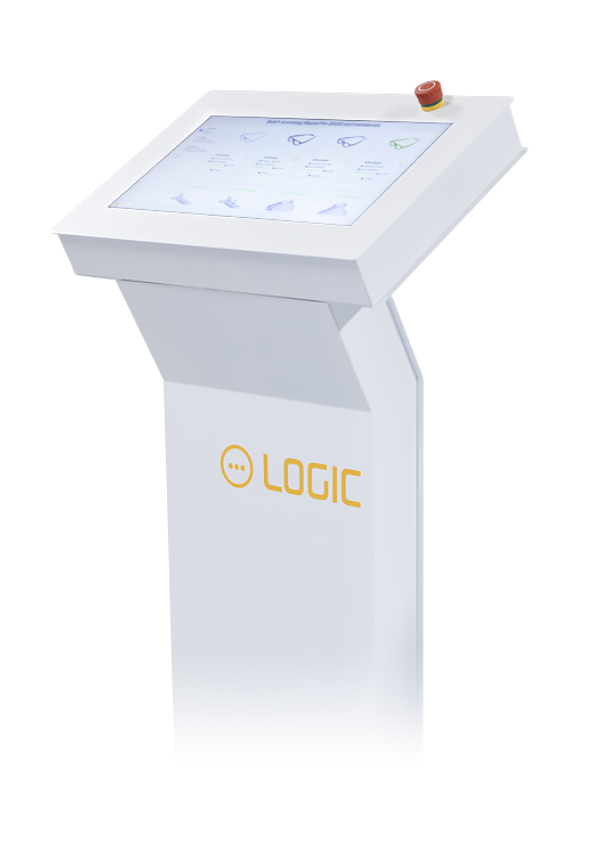
AM-Logic integrates via open APIs with ERP, MES, and PLM systems - whether purpose-built for 3D printing or standard across traditional manufacturing. Real-time dashboards on fixed or mobile consoles close the feedback loop between production and decision-making - making it faster to spot anomalies, act on mistakes, and iterate before they compound. The result is shorter lead times, lower scrap rates, and a significant reduction in the costs associated with manual oversight and post-production defects.
COMPATIBILITY
Title
Content
AM-Flow was built for additive manufacturing - and remains the leading automation solution for 3D printing post-processing. As the technology has matured, its quality control capabilities have proven directly applicable to traditional manufacturing processes including injection molding, die casting, and sheet metal, where fast, exact, automated inspection delivers immediate impact.
Every production process ends the same way: parts that need to be identified, inspected, sorted, and dispatched. AM-Flow automates that final stretch - across additive and traditional manufacturing industries where part volumes, mix complexity, and quality standards leave no room for manual bottlenecks.
3D PRINTING SERVICE PROVIDERS
MEDICAL
AUTOMOTIVE